

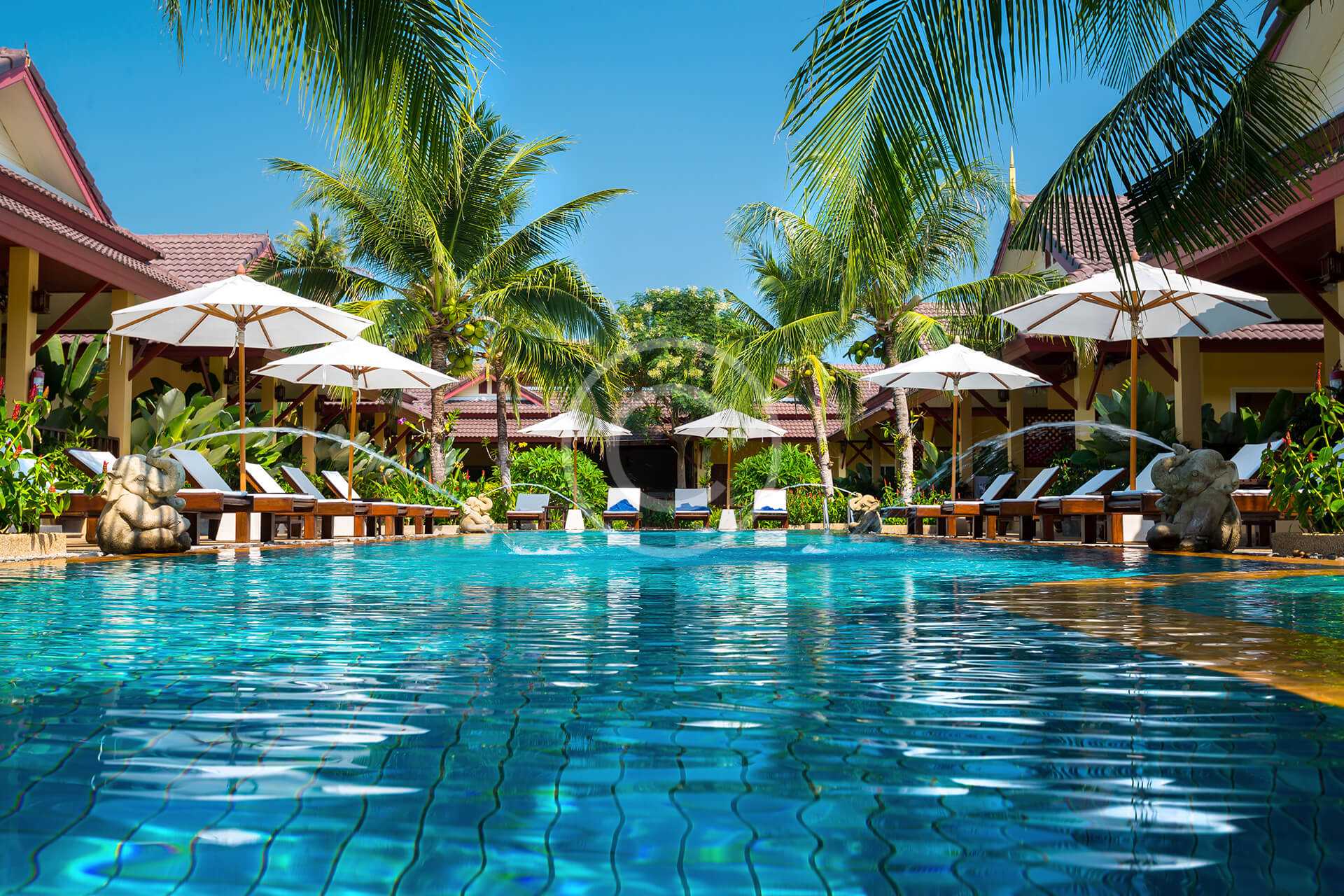
Premium hotel pool systems are engineered for appearance: infinity edges, deck-level gutters, underwater lighting, glass walls. None of that tells you whether the pool is safe to swim in. Four things do — whether the water is clear to the deepest drain, whether anyone is professionally watching it, whether you can stand up, and whether a child could reach it unaccompanied. You can check all four in two minutes, from the deck, before you get wet.
Swim schools and instructors are asked constantly about hotel pools, usually by families on holiday. The honest position is that hotel pools range from beautifully run to quietly negligent, and the building tells you nothing about which.
What the Systems Actually Do
- Deck-level or gutter overflow. Surface water runs into a channel, gets filtered, comes back. It removes the film of sunscreen and skin where most of the contamination sits. Good sign.
- Skimmer systems. Cheaper, still fine at a modest bather load, less effective in a busy pool.
- Infinity edges. A visual device. The water runs over a lip into a catchment. It removes the coping you would otherwise grab hold of.
- Automated dosing. Sanitiser and pH controlled continuously by sensor. Very good, provided somebody still tests by hand and writes it down.
- Heating. Guest pools are warm because guests want them warm. Warm water fatigues swimmers faster than they notice.
Your Two-Minute Deck Check
| Check | How | Do not swim if |
|---|---|---|
| Clarity | Look for the main drain at the deepest point | You cannot see it clearly |
| Supervision | Find the lifeguard; watch whether they scan | Nobody is watching and you are alone |
| Depth markings | Read the walls and the floor | Unmarked — assume shallow, never dive |
| Drain covers | Look at the floor | Missing, cracked or loose |
| Barrier | Try the gate | It does not self-close and self-latch |
| Rescue kit | Look for a reach pole and ring buoy | Absent — and you have children with you |
| Smell | Breathe | Strong chemical smell — that is chloramines, meaning too little effective sanitiser |
Common Assumptions That Get People Hurt
- “There is a lifeguard.” Frequently there is not, or one person is also serving drinks. Never assume, and never swim alone.
- “An expensive hotel means a well-run pool.” The two are unrelated. Clarity and cover are what you can observe; brand is not evidence.
- “It’s shallow, so it’s safe.” Warm shallow water beside relaxed adults is where the quietest drownings happen. Drowning is silent and upright and takes under a minute.
- “The floats will keep them up.” Armbands, rings and noodles are teaching aids. They slip and deflate. An adult within arm’s reach is the safety equipment.
- “One drink by the pool is fine.” Alcohol and water is a recurring feature of drowning statistics. If you are swimming or supervising, you are not drinking. Both, not either.
- “I can dive in.” Hotel pools are shallow throughout and dives into them break necks. Feet first.
- “Let’s see who can hold their breath longest.” Never. Repeated breath-holding and underwater lengths cause shallow-water blackout — loss of consciousness underwater with no struggle and no sound. In an unwatched hotel pool it is close to unsurvivable.
- “Straight from the pool into the hot tub.” Heat after exertion drops blood pressure and people faint on wet tile.
Safety With Children at a Hotel Pool
Decide before you reach the deck who is watching the water, and hand that job over out loud when you swap. “I thought you were watching” precedes almost every one of these stories. One adult, in the water, within arm’s reach, per one or two children who cannot swim. Phones stay in the bag.
Check the gate on your way in. If a toddler could push through it, the pool is accessible from your room at three in the morning, and that is the single most common route to a holiday drowning.
What Operators Owe Guests
A hotel operating a pool holds the same duties as any other operator: tested and logged water, intact anti-entrapment drain covers, a compliant barrier, rescue equipment on the deck, and staff whose certifications are current. Guest amenity status changes none of it. Facility guidance from bodies such as Sport Singapore sets out the baseline, and instructor and rescue certification frameworks published by AUSTSWIM are the standard hotel swim programmes should be hiring to.
Guests who want to actually swim are better served elsewhere. Public lap pools are cheap, lifeguarded and properly laned. If a hotel pool makes you anxious rather than bored, that is a skills gap and not a character flaw — a short block of private swimming lessons fixes it, and children should be in structured swimming classes long before a holiday. Residents get more done in a familiar condo pool. Swim schools delivering lessons in hotel pools should run the same deck check as any other off-site venue.
Frequently Asked Questions
Do hotel pools have lifeguards?
Often not, and rarely continuously. Look for one. If there is nobody, do not swim alone and do not let children in without an adult in the water.
Is a strong chlorine smell a good sign?
The opposite. That smell is chloramines, formed when chlorine reacts with sweat and skin. It indicates insufficient free chlorine and poor bather hygiene.
Can I train in a hotel pool?
Drills, sculling, push-offs, water running — yes. Lengths and intervals — rarely. Hotel pools are short, warm and unlaned.
Are infinity pools dangerous?
Not inherently. They remove a grabbable edge on one side and they attract crowds of people standing and photographing, which is a supervision problem rather than a structural one.
What should I do if the water looks cloudy?
Do not swim, and tell the front desk. A body on the floor of a cloudy pool is invisible, which is the whole reason clarity is a rule and not a preference.
Is a rooftop or glass-walled pool riskier?
The engineering is sound. The distraction is the risk — adults face the view and children go under behind them.
The Short Version
Premium hotel pool systems buy you good filtration and a lovely photograph. They do not buy you supervision. Look for the deepest drain, find the lifeguard, read the depth markings, test the gate, keep children within arm’s reach, skip the drink, never dive and never hold your breath. Then enjoy the pool for what it is.
Explore more guidance in the Swim Schools International Resource Hub, or learn about SSI swim teacher certification.
For a broader supervision and emergency-readiness framework, review the water safety education guide.

